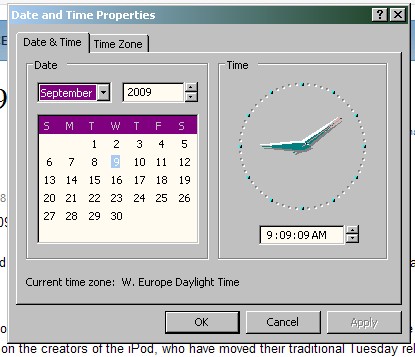
09.09.09 09:09:09

2009-09-09_090909

According to Yahoo News This is why 9-9-2009 is so special to numerologists and also in Chinese Culture:

As part of his obsession with numbers both mathematically and divine, and like many mathematicians before and since, Pythagoras noted that nine in particular had many unique properties.

Any grade-schooler could tell you, for example, that the sum of the two-digits resulting from nine multiplied by any other single-digit number will equal nine. So 9×3=27, and 2+7=9.

Multiply nine by any two, three or four-digit number and the sums of those will also break down to nine. For example: 9×62 = 558; 5+5+8=18; 1+8=9.

Sept. 9 also happens to be the 252nd day of the year (2 + 5 +2)…

The article then goes on to say:

The Chinese pulled out all the stops to celebrate their lucky number eight during last year’s Summer Olympics, ringing the games in at 8 p.m. on 08/08/08. What many might not realize is that nine comes in second on their list of auspicious digits and is associated with long life, due to how similar its pronunciation is to the local word for long-lasting (eight sounds like wealth).

Historically, ancient Chinese emperors associated themselves closely with the number nine, which appeared prominently in architecture and royal dress, often in the form of nine fearsome dragons. The imperial dynasties were so convinced of the power of the number nine that the palace complex at Beijing’s Forbidden City is rumored to have been built with 9,999 rooms.

So, I guess what makes my day special is that I not only managed to get one photograph – of my computer screen at 9/9/9 9:09:09 – but one of my desk clock as well:

09.09.09 at 09:09 am

And.. since the next set of repeating dates will not be until next year (10/10/10 at 10:10) – it just makes it that much more fun.
How cool is that?

Share

Howth (rhymes with Both) Ireland

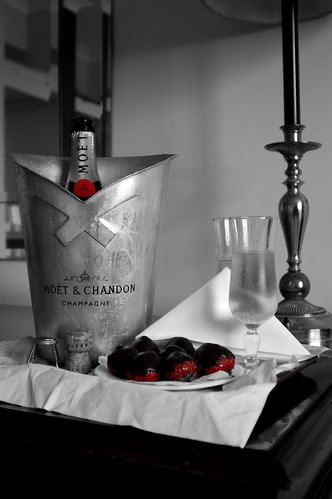
Chocolate Covered Strawberries

In July I had a few days off, and found an inexpensive trip to a day spa / hotel just outside Dublin Ireland.  The town is called Howth (Rhymes with Both), and it’s on the North side of Dublin Bay. Pulling up through the gates by taxi, I was impressed

Howth Castle Gates

by a pair of lovely gray stone gates. On one side of me was the sweeping view of the bay and on the other, Howth Castle. We were going up the hill, to the Spa at Deer Park. When I got there and was checked in – there was a bottle of Champaign and a lovely dish of chocolate covered Strawberries waiting (A sure sign of a relaxing time to come):

Champaigne & Chocolate Strawberries

What I can say is that I’m glad to have taken several days enjoying the wonders of the spa and golf courses at Deer Park.  Even though I don’t golf, the area is lovely – lush and green – the courses being made on the old Castle Howth Grounds.

Howth Castle
Howth Castle

As I mentioned, the spa itself sits up on top of a hill – overlooking Dublin Bay on one side, (behind the castle below)

Howth Castle and Dublin Bay

and a pair of islands dedicated to bird sanctuary on the other (My room had a view over the golf course down to the islands).

The View out my Window

Unfortunately, while there, I managed to gunk up my main camera lens – which means that I didn’t get to take photos other than the first day.  While I did get it repaired in the city – I didn’t get it back until the day I was leaving.  So, I guess you could say I saw the sites, committed them to memory – and didn’t even get to take photographs of them all.  It’s a shame – but here’s a few that I did take (all from the first couple hours) are now online with a sampling below. ( my flickr set is here for more).

St. Mary's Church Howth
St. Mary’s Church – Howth (anglican)

St. Mary's Church & Roses
St. Mary’s Church Door with Roses

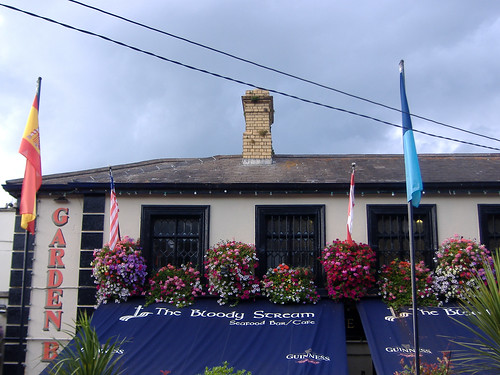
The Bloody Stream
The Bloody Stream (I admit I thought it said SCREAM) where I had a tasty dinner of tomato soup, crusty bread and pasta.(It’s right outside the train station)

Howth Marina & Lighthouse
Howth Marina and Lighthouse

Share

Jüterbog Day Trip

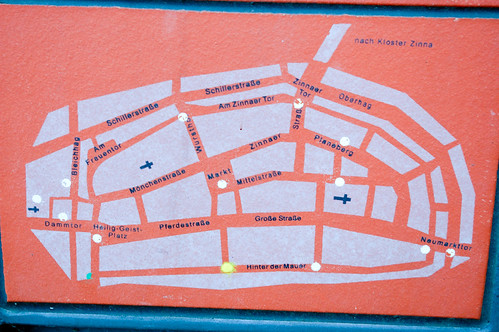
Ringed Town layout.
City Map (notice it’s round like the city walls)

June 6,2009 – I took a day trip to Jüterbog. It’s not too far from where I live but is a very cool place because it retains its full city walls from the middle ages. It turned out to be very gray and rainy in the afternoon, but it was a decent bike ride (after the train trip down) anyhow because it was a warm rain.
More information is at: en.wikipedia.org/wiki/J%c3%bcterbog But the summary (interspursed with my pictures) is:

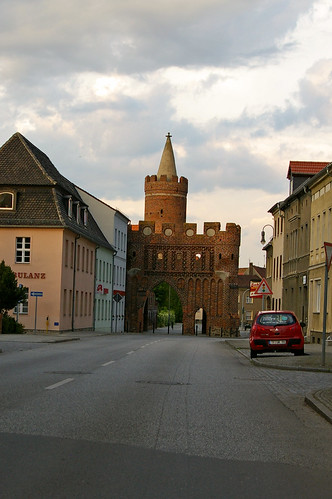
First mentioned around 1000 as a town, The town is surrounded by a medieval wall including three gateways and barbicans.

>Dammtor gateway Exterior

Dammtor gateway Exterior
Dammtor gateway Interior
Dammtor gateway Interior which would have been used as the militia rally/training point it was literally right outside the main city gate towers below:

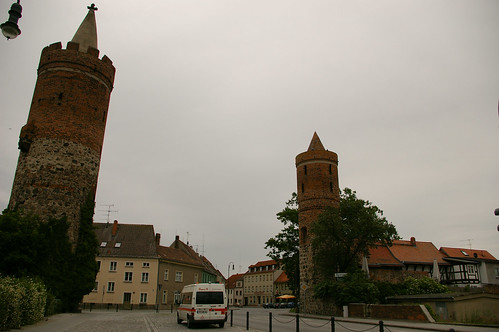
Old City entrance watch towers (both)
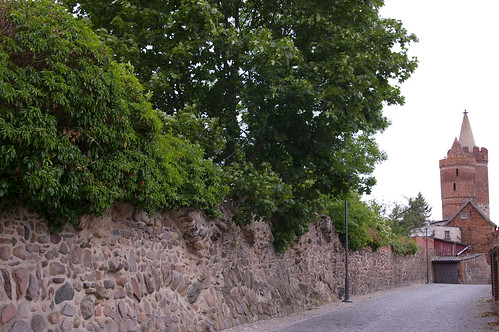
Old Midevil city walls to the main city gate
The old city walls – about 8 feet high – looking back to the gate
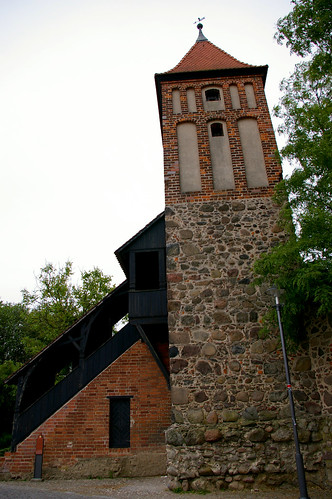
Watch tower
Intact Watch tower along the city walls

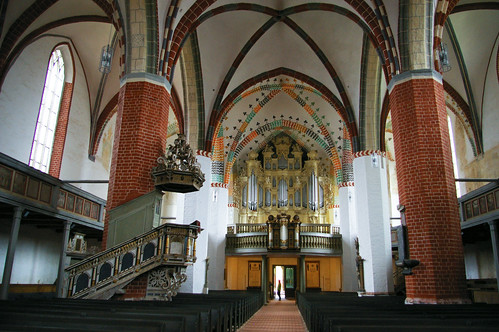
Jüterbog encompasses two Protestant churches, of which Gothic St Nicholas’ (14th century) is remarkable for its three fine aisles and features a preserved coffer (chest) of Johann Tetzel, and original paintings.

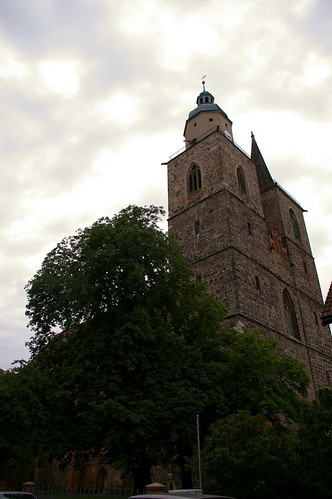
St. Nicholas Church
St Nicholas’s Church – Juterbog was First mentioned in 1307, back then it was a Romanesque basilica. The church today is a gothic hall church – built in 3 stages which can be seen in the ground plan.
First stage – The long nave between the slanting outer pillars (1330 – in black)

Second stage – lengthening to the west, a cross beam, and the west end (1440 – grey)

Third stage – alteration of the alter apse and building of the ambulatory (1488 – light grey)

Central Nave, looking back to Organ
Inside – looking back toward organ

The building of the towers were not finished before the beginning of the 16th century. The different tops are due to the circumstances that the spire of the northern tower was knocked down by a thunderstorm in 1560. After that, the octagonal construction was built by taking the 30 unused altars of the catholic time as material to create room for the watch man. This baroque top was put on in the year 1617 and still adorns the northern tower.

The church survived the conflagration in 1478, The Thirty Years War, the occupation of the town by Prussia rom 1756 to 1763 in the Seven Years War, and the first and second world war almost unharmed – unlike the town and residents.

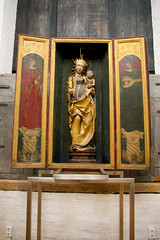
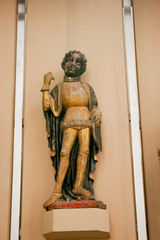
Inside, You will find a famed Madonna and Child from the 1500’s, and a statue of a black St. Maurice from the 1400’s.

Madonna and Child TrypticHand carved St. Maurice from 1500's
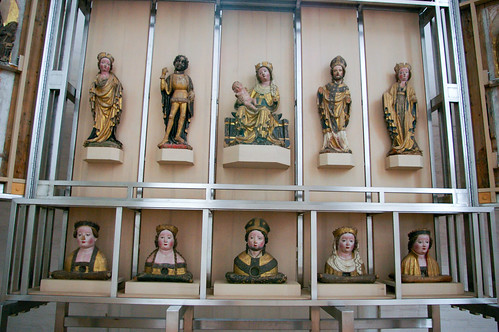
and a whole set of other states that are hand carved from the 16-1700’s

Hand carved wooden saints

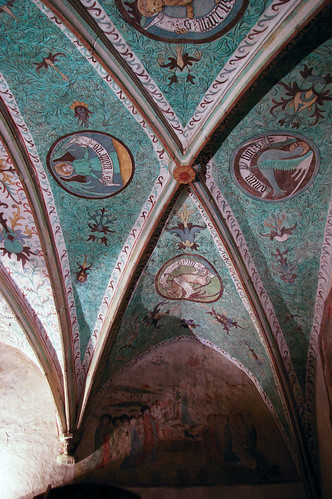
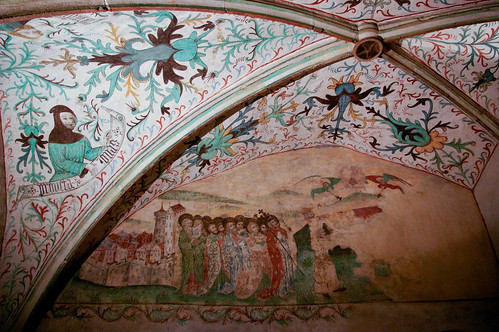
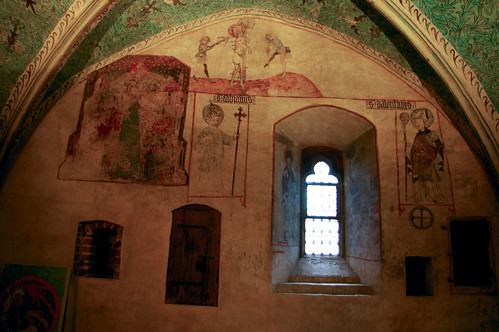
Most Impressive, however, is the original side chapel – with original Painting (you need to go to flickr to see more of these) which are dark b/c of NO FLASH allowed:

1300's Side Chapel paintings 9
Tourquoise Roof With Angels
1300's Side Chapel paintings 8
Pilgrims to the Holy Land
1300's Side Chapel paintings 6
Saints

Jüterbog carries on weaving and spinning both of flax and wool, and trades in the produce of those manufactures and in cattle. Vines are cultivated in the neighborhood.

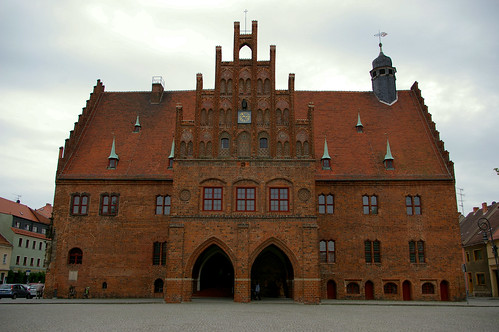
Rathaus Juterbog
Town Hall (built for the trading of flax, wool and coal).
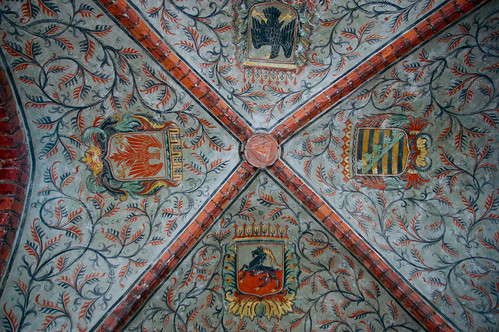
Coat of Arms
Town Hall Ceiling
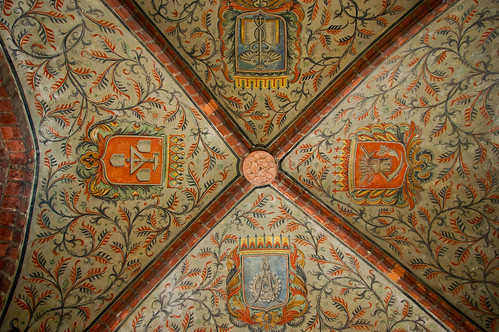
Ideal coat of arms
Town Hall Ceiling 2

That’s it from Jüterbog, but be sure to check out more of the set here.

Share