When I was born, the Berlin Wall had already been up for 15 years. The main city of Germany – the one with the largest population after the war was literally split in two by a wall which surrounded nearly 130 miles around the city – a wall which went through 3 phases – between 1961 and 1989 until it wound up being two meters high. The final phase of the wall was a foot thick, steel reinforced concrete, topped by barbed wire, and built in massive slabs that could only be moved in place by cranes or bulldozers. And it wasn’t just one wall. It was two of these masses – divided by a 40 meter (~25 foot) death strip which was divided by lookout points and patrolled by guns. Scary.
One of the first things I remember growing up – was hearing a few family stories about my uncle Jeff who had been stationed in Germany – not in Berlin – but close enough to where for several years of being here – he wasn’t able to travel and could judge the cold war tension between the west and eastern (former soviet) sides of Germany. Famiies had been divided, a city’s industry and resources cut in two, and militaries had once again faced off tank against tank – across the border near checkpoint charlie. To say the least, it was an uneasy time for all whether you were inside or out of the barricade. And thus, my second memory of the city, was the speech in 1987 – I was 11 – where Regan asked “Mr Gorbachev – Tear down this wall!”. I wasn’t here, and I didn’t understand why the wall was there – or about communism or republicanism or why our governments were engaged in the cold war. What I thought at the time was “why?”.
Then, my freshman year in high school (1989), I was lucky. My school had gotten a grant from several industries including IBM, CNN, Southwire, and Phillips – to be ‘upgraded’. This meant that our school got hard wired for TVs and VCRs in every classroom, as well as 7 computers hooked to the internet, education software, and a few other “bonus” things. At the time, we all thought it was cool but didn’t really understand how much this visionary update would change our lives in the coming years (if it wasn’t for this, I’m not sure I would be doing what I am today). Out of this grant, we were required to watch 15 minutes of “in the school news” combined with world news provided by CNN especially for schools. Sounds boring – and most of the time it was. Only one day (November 9, 1989), when we came into school – our homeroom teacher turned on the tv to CNN and said, class, I am not teaching you a lesson today. I want you to watch the news for the next half hour. Some of us were relieved, others studied – and some of us went well, it must be important if we’re not being taught. Little did we know…
At any rate, I remember thinking she was slightly strange (the tv was showing scenes from Germany where people had been protesting for months)- but in the next hours, we saw all we needed to see. Students, protesters, chanting, yelling “”Wir wollen raus!“” (we want out) or “Wir bleiben hier“, (“We’re staying here!”) – carrying banners and signs on both sides of the wall – removing the barbed wire in the darkness – swarming the death strip – to no gunfire (the guards superiors didn’t want to be the ones to order lethal force on crowds). And then it happened. The first people started to climb on the top of the wall…. and the school bell rang. We were rushed on to the next class. As students, we were talking about it – and the next teacher in there agreed to turn on her TV as well. It was my French class – and we were supposed to have a Test…. which after seeing the news, she postponed to the next day. It was as she turned on the tv, and we insisted it was important that suddenly a guy in a black leather jacket was standing on the wall, reaching down, and taking a sledge hammer from someone in the crowd – and the rest was history.
The first few hits of that sledge hammer must have sent hard sharp shards of concrete shrapnel into the crowd. I can’t imagine how much those little pellets must have hurt – but maybe it wasn’t so bad – it was for reunification, after all. As we watched, suddenly a roar went up – Success! The barriers were chipped away – moved gradually piece by piece until there was a hole in the wall. A hole through which East and West Berliners reached out and shook hands for the first time in 38 years. All this happened pre social networking sites like twitter or myspace (which are leading Iran protests now as I type this), pre-web 2.o, pre cell phones or texting. And somehow, it happened. People knew where to gather – when – and what to do – Peacefully – to reunite their city and their country.
17 years later, I moved to Germany. To Berlin
The city was reunited and my first impressions of it were that of the 2006 World Cup Match being held here. I heard from all my colleagues how this was the first time they had really realized that this was Germany – One Germany – Really Really One Germany. They had never seen German flags fly over anything but government buildings. Patriotism just didn’t exist – only – suddenly during the World Cup, German flags were everywhere. On buildings, on cars, on balconies. They were on hats and tshirts, pins, buttons, windows and anything else you could possibly think of. It was a resurgence of national pride.
I’ve lived here for 3 and a half years. It’s been good, bad, and well, at times, very different from my own native USA. This year it’s the 20th anniversary of the “fall” of the Berlin wall. There’s events everywhere – Alexanderplatz, Checkpoint Charlie, Potsdamer Platz. Theyve even published bicycling maps so you can take your bicycle and cycle the entire “path” of the wall around the city and see where it was, where it is, and how things are being “put back together” (Progress). Thing is – there’s events and memories that I’m seeing happen here – but he biggest one that I’ve seen isn’t so public.
You see, in the last year, the street that I live off of – used to end just after the apartment complex. The wall was less than 1/4 mile away. It was there – overgrown in the woods along the canal (I walked the dog by it – he peed on it). This Spring, road construction made the road longer – and connected it to Berlin. It’s now a major town thoroughfare. The by-product? That wall that I had walked the dog by – well, it’s gone. Bulldozers took all the pieces of it pushed them into bunches on the old death strip – and they’re being “recycled”. They’ve been pretty inaccessible because of the road construction and fences. Much like everything in Germany, though – eventually if you watch, someone puts a hole in the fence – or removes one side of the fence alltogether. With a little initiative – no one says anything – and you can go in and break off your own piece of the Berlin wall – or…
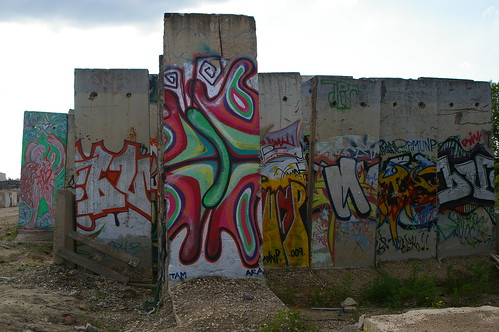
In my case – take pictures. Of History. Before it’s gone. So, here’s my impression of “my” wall – 1/4 a mile from the house – in Teltow. 20 years later.
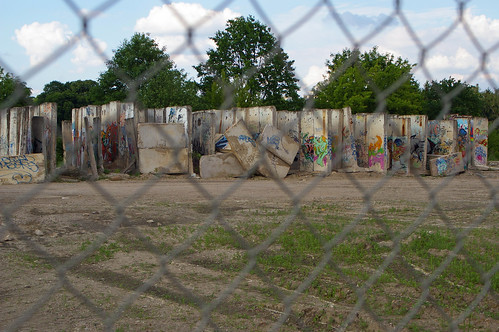
Mental &Physical Walls


Holes and Cracks
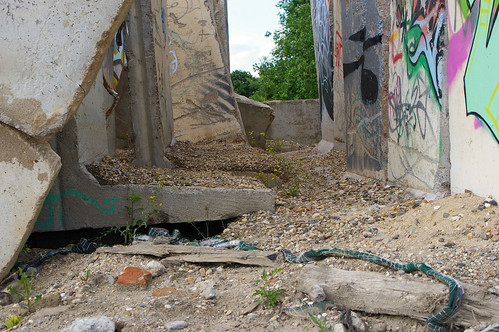
Undermined by Erosion
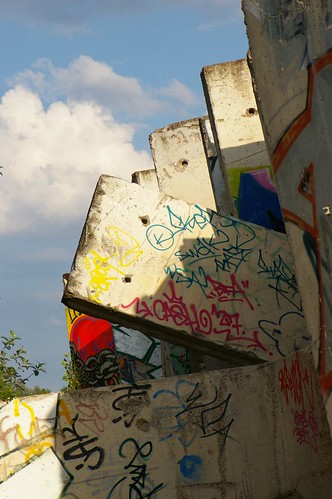
Chains on My Heart, but the Walls are falling….
So, last but not least, I just want to show that there is Life on the Death Strip – and there there is still hope. In my eyes, I am watching Iran, North Korea, and China – hoping for an outcome like the one I witnessed on TV in 1989. Time will Tell, but where there is only gray, sometimes all you need is the colored glasses of youth.
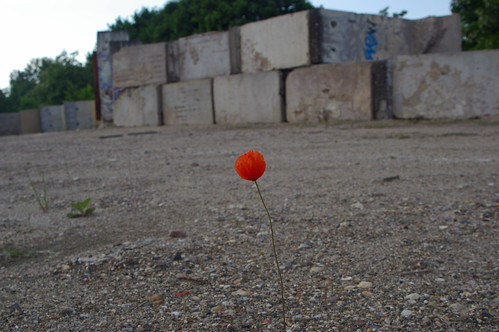
As always, you can find more on My Flickr Site in the photo set “Berlin Wall in Teltow”
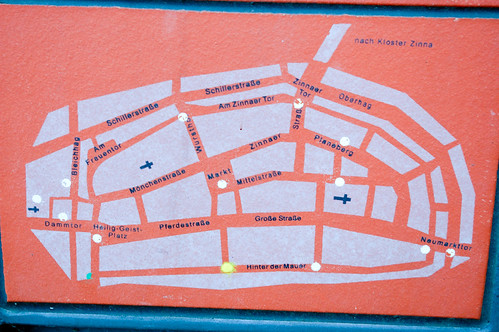 City Map (notice it’s round like the city walls)