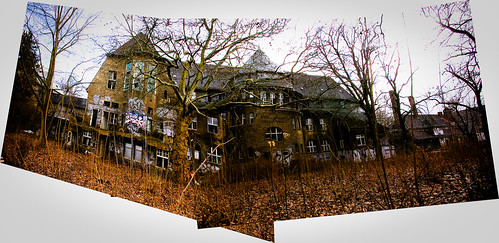
Abandoned Säuglings- und Kinderkrankenhaus Weißensee

Kinderkrankenhaus Weissensee

For some reason, it seems that Germany just has a surplus of abandoned buildings. Perhaps it’s because of the two world wars and the subsequent soviet occupation. Perhaps it’s because the people here respect quality building and simply hope that someday someone will restore these old buildings to their former grandeur. Perhaps it’s because they simply don’t have the time, money, or the “gotta-wanna” to tear them down once they’ve become unsafe.
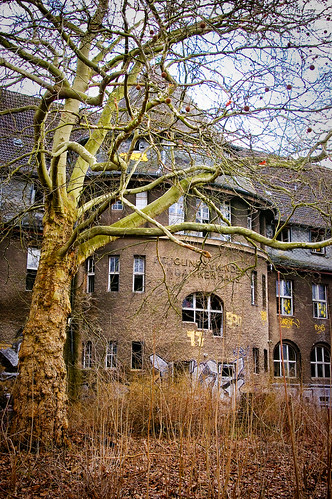
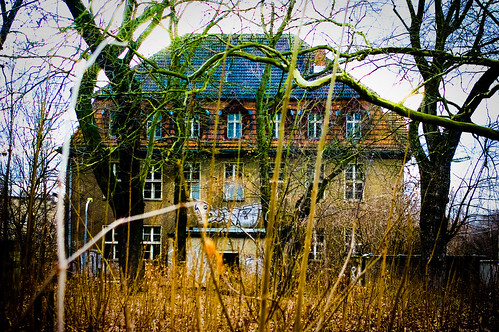
Center view Main Building

On yet another of our photo group outings (March 13,2010 – yes, I know I’m way behind!) , several of us decided to go up into the North East corner of Berlin (former Soviet territory, which is now sort of an up-and-coming trendy area) near the Weissensee (White lake) to check out an old infant and children’s hospital there – literally named in German – Säuglings – und Kinderkrankenhaus Weißensee (infant and children’s hospital on the White Lake). Getting inside was surprisingly easy – you just needed to walk between an old electrical box on the street at the break in the gate. The main problem is that there’s a tram stop directly across the street – and the opening is on a busy street, so you have to time entry just right so as not to be seen. (Though, I doubt anyone really cares – since there were about 5 other people there and a number of squatters too.) The entire flickr set is here.
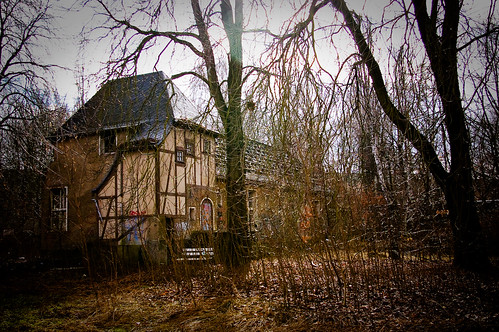
Stables & Offices

The original building complex (oldest building at the top above) was drawn up by architect Carl James Bühring in 1909. The main building itself was completed in 1911. The plan was that this hospital would help to handle the increasing birth rate in the city. Starting in 1912, other buildings were added and as it grew, this hospital became the first communal childen’s hospital in Prussia. Most notably, there was an on site stable (photo above with the 1/2 timbered architecture) which had cows between about 1912 and 1920, which produced high quality milk for babies in need of breast milk substitute, and also for provided “milk therapy” for older children weakened by sickness. The newest building (below) seems to be the nursing ward/ infirmary added in 1987 with two floors and semi-modern laminate floor tiles.
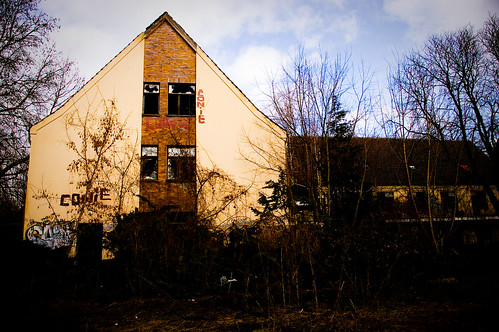
Nursing Ward / Infirmary

The hospital was closed on 1 January 1997 and sold in 2006 to an investor group. According to stated plans, they want to establish a cancer center on the property, using what they can of the old buildings. To date, no progress has been made, and it’s unclear if they will be able to use any of the property in their plans. The estimated date for the new center to start construction is in 2011. (A few more complex buildings below – Side building, Surgery building toward the main old hospital, an administration building.)
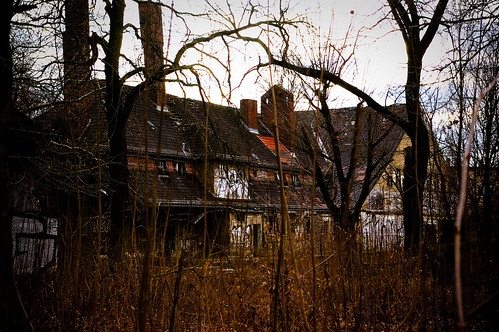
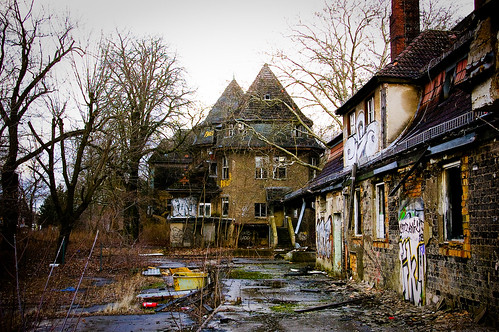
Side Building

Surgery Building looking toward oldest bldg

Administration Building

In the meantime, this provided a good opportunity to explore a few of the several buildings and get some nice photographs of the sorry state of these buildings in their decay and deterioration. To say the least, because of it’s easy accessibility, this is an area that has been inundated with graffiti artists, taggers, vandals, and squatters. (On one floor of the infirmary/nursing ward we found an ENTIRE room of people and dog shit – talk about nastiness and stench – which had been repeatedly used for such excretions – and which we quickly ran past.) Anyhow, I hope you enjoy what I think were some of the best photographs of the day.

Main (oldest) building from 1911:
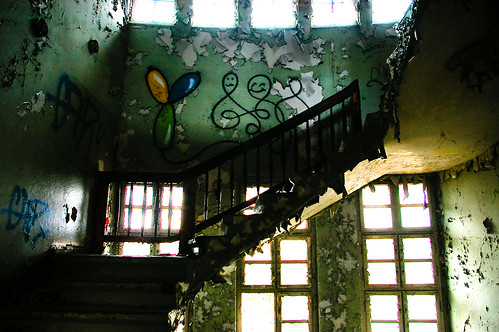
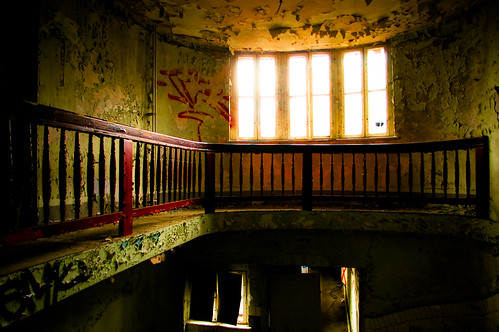
Curved Staircase
Curved Staircase and large windows
Narrow Balcony
A narrow balcony
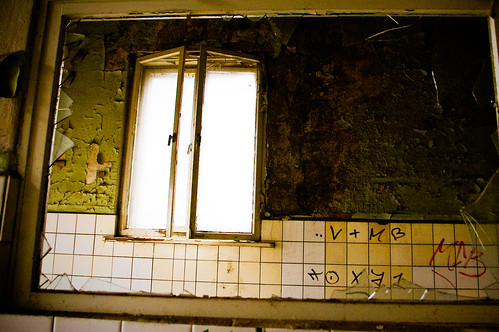
Green Wall
Green Wall & Tile through a broken window.
Operating Room
Operating Room
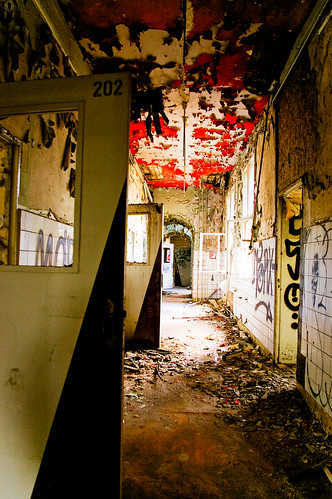
Red Ceiling and half doors
Red Ceiling, Red Half Doors, Red Tile Floors (very creepy)
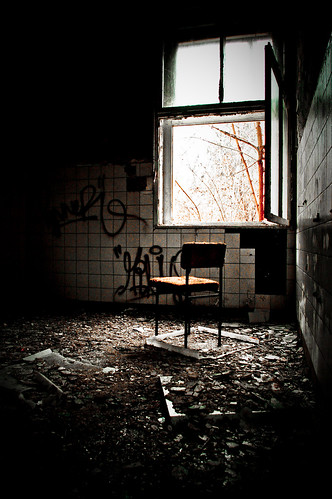
Red Cushion Chair
The Lonely Chair

In the Other Buildings (as labelled):
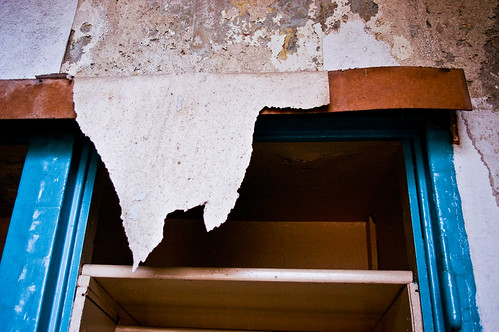
Peeling Wallpaper
Peeling Wallpaper in the Administration building.
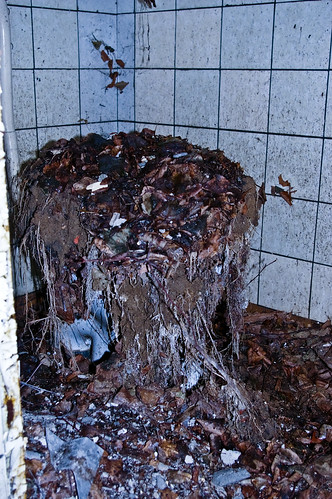
There's a toilet under there
There’s a Toilet under there – collapsed roof in the Stables building
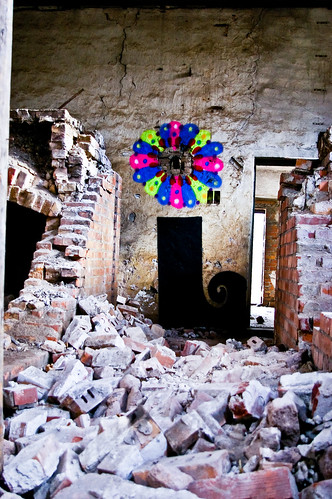
Brick & Neon Flower
In what would be the Wash house/boiler house – the bricks had been removed from several areas – and piled into a single room – shoulder high.
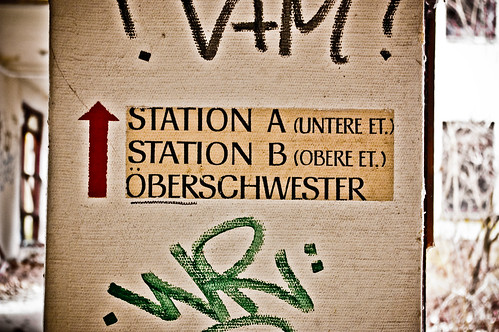
Nurses Station Sign
To the Nurses Stations (Infirmary ward)
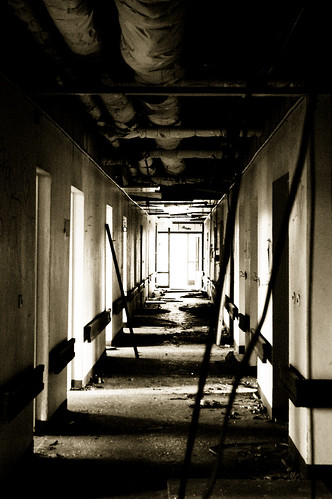
to the Nursing Ward
Empty Infirmary Ward
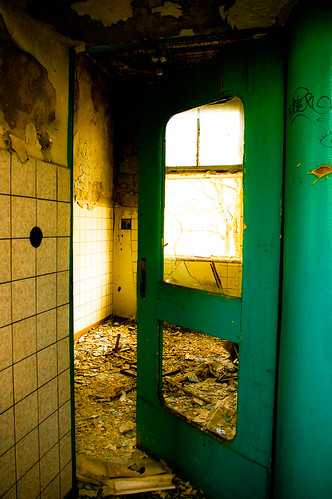
Blue Surgery Door
Blue Surgery door (surgery building)
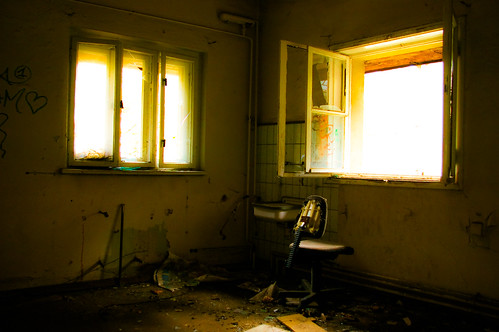
Lone Office Chair
Office Chair in Exam Room (Infirmary Building)

Tomorrow, a post about graffiti. All about Graffiti….

Share

The Ass-ault of Gransee

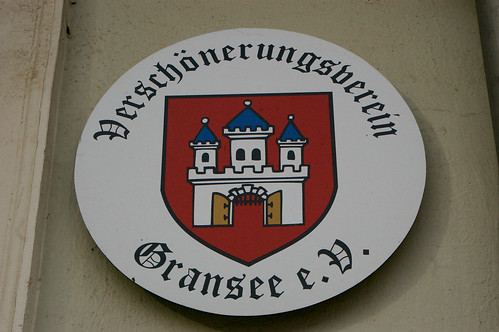
Gransee Coat of Arms

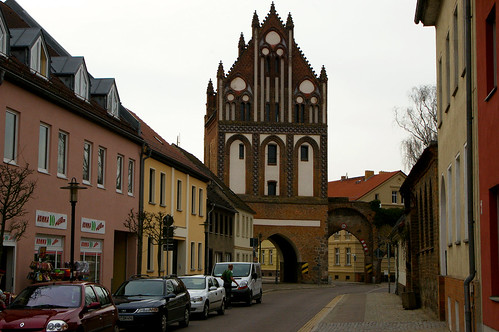
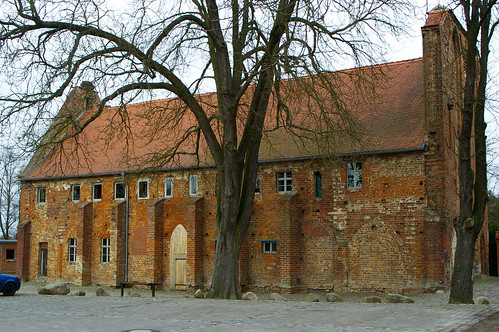
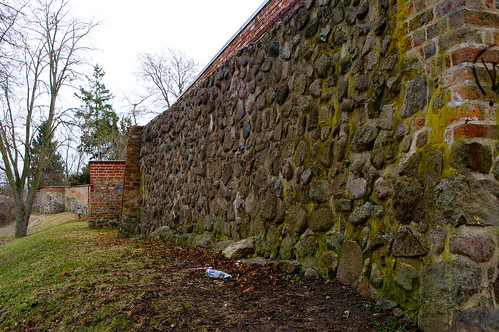
The same day that I had off (March 26) and went to photograph the Swans in Neurippen and the Palace at Rheinsberg, the last place that Michael and I stopped on our historical site tour was a town called Gransee. Now, generally speaking, I’m all about these great old (from the middle ages) towns that still have their old city walls and a bit of the old buildings and watch towers. I’ve been to a few, and they’re cool – each in their own way. By far, the nicest thing I can say about this town is that they have really preserved their city walls – with 1750 meters of them (originally some 2000 meters) still intact. Part of the wall includes the main gate,

Main City Gate, Gransee

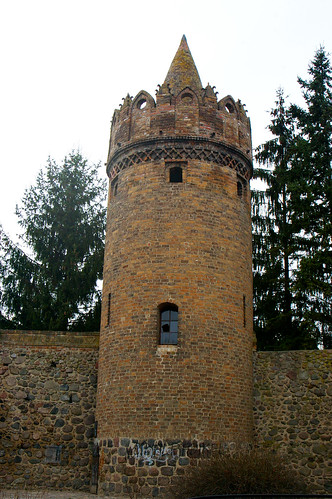
the powder tower (built around 1500):

The Powdertower (pulverturm)

and the Franziskan Cloister church ruins (built in the 1300’s):

Franciscan Cloister ruins

Why is it so preserved? Because the entire city wall area that remains (outside part) is surrounded by about a 1 acre wide park with bicycle paths and play areas for the kids – which means that it’s become usable recreational space – instead of a hindrance to people and traffic (which is what encourages them to be dismantled):

North side of Gransee City walls

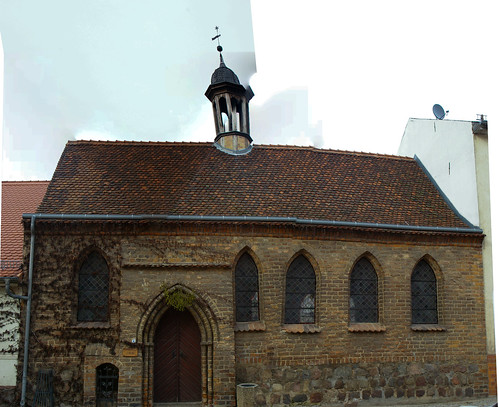
The thing is, though, that after parking the car and getting out to head to the local museum (housed in the oldest church in town):

Gransee History Museum

We were ass-aulted. Literally. There was this horrible noxious scent of ammonia base that just became stronger each and every time the wind blew. It almost made you sick to your stomach, and you didn’t want to dare open your mouth to speak – lest the taste of ammonia based SHIT invade. Promptly covering my face with my t-shirt, I said “UGH! Chicken Farms!!”. It’s true. There are apparently chicken farms nearby – but where at, I don’t know – other than within smelling distance.

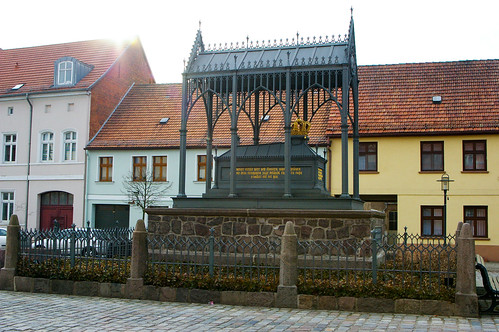
Upon snapping the few pictures above, Michael and I dashed into the historical museum (which smelled delightfully old and musty), checked out a couple of things inside there (they were closing for the day) and headed back out into the pungent town again. To say the least, the scent hadn’t abated (I think it actually had grown), and we were thankful this is a VERY.SMALL.TOWN. We hit a few more local highlights, walking quickly, holding our breath and alternately breathing through our shirt/hand/scarf. We paused to take a picture of the town square with its monument to the Prussian Princess Louise (she died nearby and the body was carried through town in 1810):

Luisendenkmal am Schinkelplatz

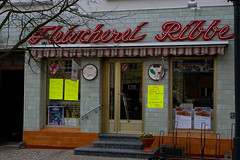
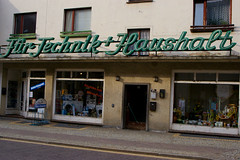
a couple of the local signs that I found interesting (very retro – maybe from the 1950’s?) -:

Fleicherei Ribbe (Ribbe's butchery) Fur Technik Haushalt (for Technical Households)

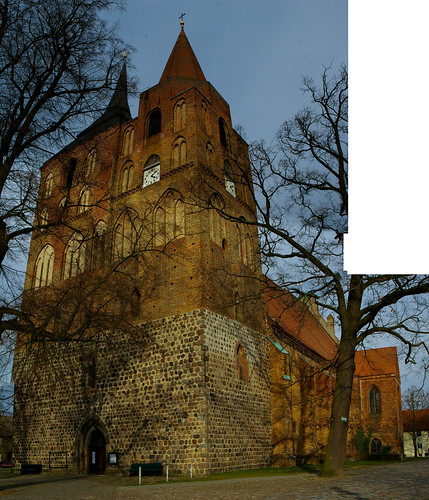
The first being a butcher’s and the second being a “household appliances” store -and then got the outside of the local church (St. Marienkirche):

St.Marienkirche (panorama)

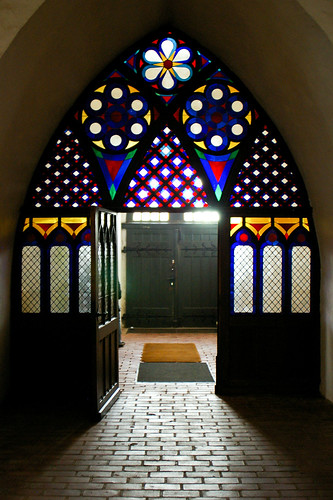
I then couldn’t take it anymore, and I begged to go inside (for fresh, cool, ancient incense smelling air) to make a couple photographs of the stained glass entry:

Entryway St. Marienkirche

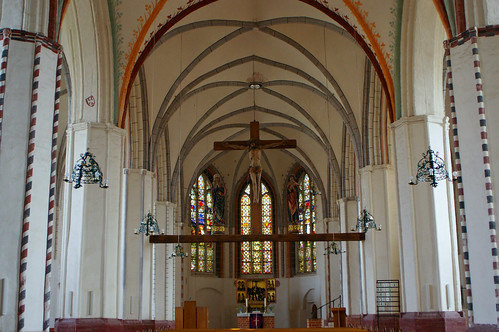
and the center aisles.

Inside Center to altar St. Marienkirche Gransee

When the church closed to visitors (5 minutes wasn’t enough other than for me to just get the stink out of my nose before having to fill it up again), we nearly ran back to the car. (And believe me, we weren’t the only ones – even the towns people seemed to be racing about ducking inside for some non odor-filled air.) All I can say is that the town was neat, and I liked the idea of how they used their ancient city walls – but OH MY GOD, What the HELL is that SMELL? Even weeks later, as I write this, it is the one thing I remember most about Gransee … shame, that! (Notices that as she types the blog, she has been repeatedly rubbing her nose at the thought of the town… ah.. strange associations!)

Share

A Palace to Relax

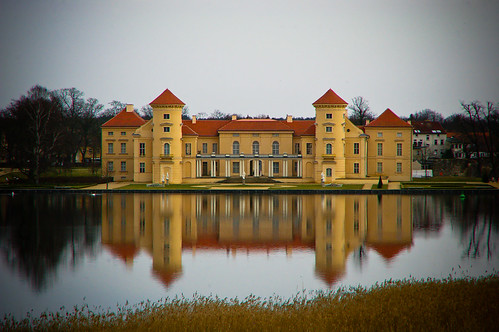
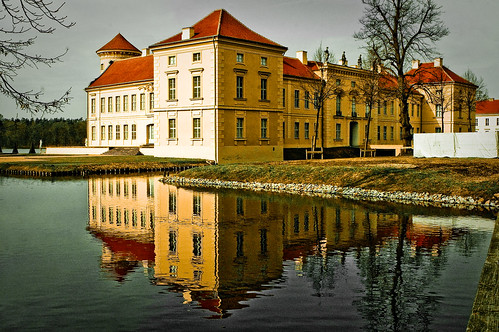
Rheinberg Palace (rear view)

***Long Post full of pictures, please give it time to load***

When you are the King of Prussia, Frederick the II (aka Frederick the Great), and you enjoy beauty, art, philosophy – AND you didn’t really want to become king (that is – until your father executes a childhood friend right in front of your eyes), what do you do? You rebel as best as you can by trying to make things better – for everyone. Let me Explain.

Frederick was a proponent of enlightened absolutism. Simply put, Fred embraced the principles of the Enlightenment, with its emphasis upon rationality and applied these principles to his territories through religious tolerance, freedom of speech and the press, and the right to hold private property. In addition, he worked to encourage the arts, sciences, and education. How did he do this? He became friends with great thinkers like Voltaire and worked to modernize Prussian bureaucracy and civil service, oh – and he composed music – for the flute. Yes, the flute. Now, in modern society, we would naturally, assume, he was gay. Maybe he was – after all, despite being Married to Princess Elisabeth-Christine – he died childless – but hard telling – because back then, it would have been something swept under the rug….but you can read more about his life (and sexuality speculation here) if you want.

Anyhow, during his reign, as a part of his beliefs (he was, after all, well educated and very liberal for his time) he thought that he should rest in beautiful palaces – his favorite, was Sansoussi, near Potsdam (flickr set here), where he died. His second favorite, however, he spent several years in – just before he came to power. It is Rheinsberg Palace (pictured above), located in the North of Brandenburg. It was here, in Rheinsberg, that Fred assembled a small number of musicians, actors and other artists. He spent his time reading, watching dramatic plays, making and listening to music, and regarded this time as one of the happiest of his life. Seeing the palace above, I can understand why.

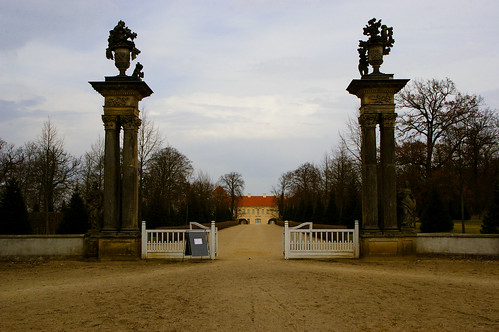
Rheinsberg Entry Gate

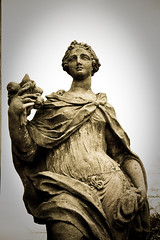
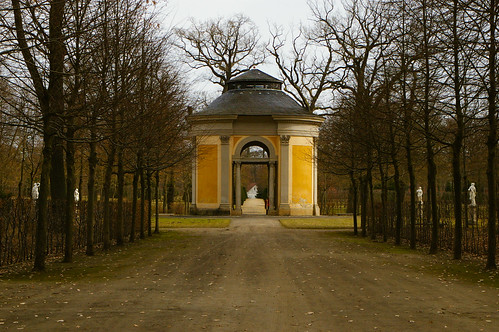
The grounds are, even today – magnificent. When you enter through the gates, erected between 1734-1744, you get an immediate sense of grandeur. At one end there’s the brilliant yellow palace, framed through the column gates. The columnades and hedges along the entryway instill a sense of balance, and the female Greek goddesses you pass by on either side a sense of the classical and the timeless.

Rheinsberg Entry Gate Statue Right Rheinsberg Entry Gate Statue Left

Partway down the main entryway path, you come to a cross road. In front, there is the main palace and its white carriageway bridge. To the Right, there is a path that continues into a wooded area filled with trees and paths to wander. To the Left, is the entryway to the maze and path around the far side of the palace. I chose to go to the left, because the weather was nice, and a storm was moving in. At the heart of the maze’s wide pathway, there is a lovely gazebo which is surrounded by several white marble Roman style statues. It has a tiled “sun pattern” floor, and the ceiling inside is a mosiac patterned cherub (no pictures, unfortunately they didn’t come out).

Gazebo in the Maze

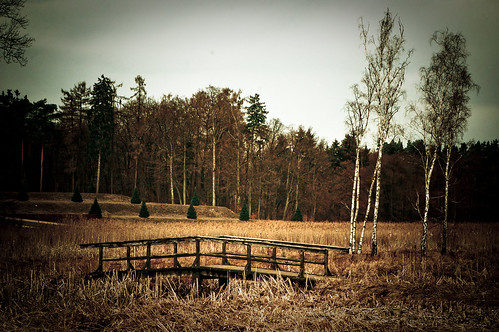
From there, I proceeded on, past a terraced hill of grape vines and down into the marsh area where you can choose to go across a wooden bridge (it looked not so sturdy from far away):

Bridge across the creek

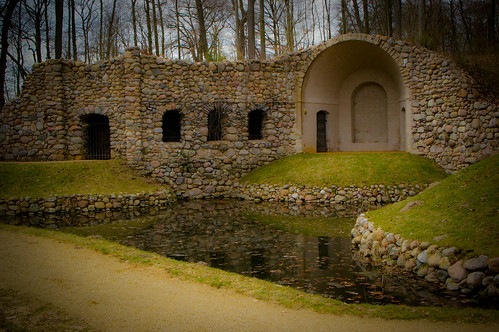
or head toward a man made grotto and pond – which was added during the expansion of the garden area between 1752 -1802 by Henry (Fred’s brother).

Grotto on the Grounds

The Grotto is now closed and locked up (I walked around in front of it) but I can just imagine playing in there on a hot summer’s day – the inside is large enough for a couple of benches and a card sized table – with the fountain down the one side gently gurgling away.

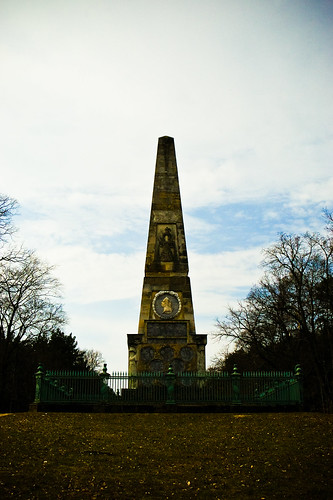
As I continued along the path around the edge of the lake, more woods appeared and a large marshy area filled with cat-tails. A small sign says that this is where the old boathouse once was – just as the rear view of the palace starts to come into view. At the same time, up to the left, a grassy terraced hill begins – a hill that once belonged to the townfolk of Rheinsberg but was confiscated by Henry during the expansion of the grounds – and it is topped with a huge oblisk surrounded by a green fence.

Monument to Louise?

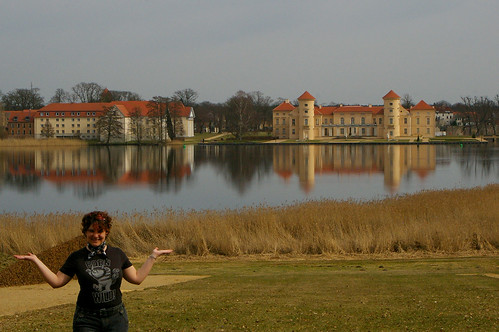
On the Oblisk are several profile medallions – and dedications to various kings / queens / princesses of Prussia. The pathway continues on; leading around the hill. Upon turning around, I realize I’ve reached my main objective – and wait on the light to give me what I want – a photograph of the Palace and it’s Guesthouse reflected in the lake in the sunshine… And so I wait. 5 minutes, 15 minutes, 20 minutes, baking in the humidity, I set up the camera, tripod and timer. I strip off my sweat jacket and wonder if the clouds will part and the water still…. People pass by. They climb the hill and wander around us. Finally, I give up – to head toward the palace itself – and decide to have Michael snap a photo of me, shrugging – the “what can ya do?” expression….

Me (Can I have this place?)

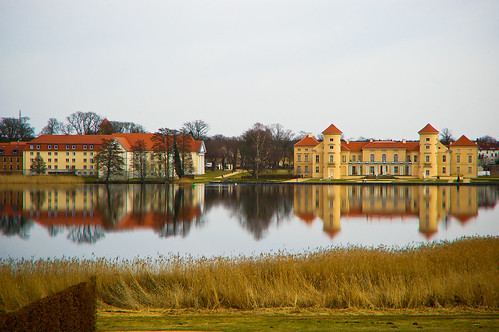
And then.. as I start to take the camera off the tripod, the clouds part over me – and the winds calm just enough to give me this:

Rheinsberg Palace and Guest house

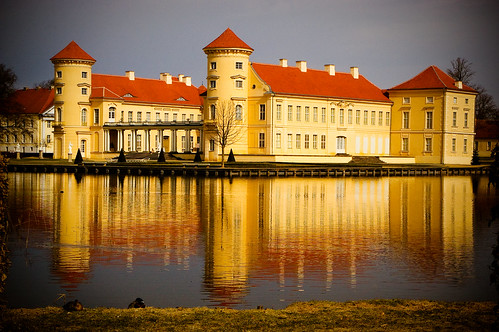
which I was quite pleased with. Heading back around the lake, the sun grew more intense, and with just moments to spare, I managed to snap two more views of the palace – before the sun left for a few hours — and the intermittent rain showers began.

Rheinsberg palace from the "maze"

Rheinsberg Palace front view

Side and Front views of Schloss Rheinsberg.

All in All, not a bad day for photographing a Palace – though I do think I want to go back when it’s in bloom, later this summer, with a picnic — to find a Place at a Palace to Relax.

Share