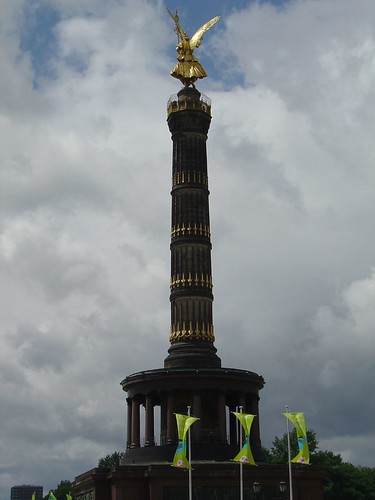
Recently, I was lucky enough to participate in a tour of Berlin’s Templehof Airport. Called the Mother of All Airports, Berlin’s Templehof airport will close in the Fall of 2008 and become well, we don’t yet know what.
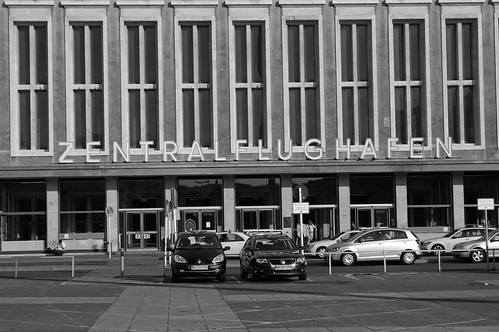
To understand Templehof airport, you need to understand that it has, after nearly 300 years, become an integral part of Berlin’s culture and history. Pre WW2, the airport was used as a Royal Prussian parade ground starting in and around the 1700’s. From around 1895 to 1918, in between being used as a parade ground, the airport served as a demonstration area for hot air balloons, airships and aircraft.It was also was
Quoting The Local “the scene of an Orville Wright air-show in 1909, of zeppelin flights in the thirties, and in 1948 – 49, of the Berlin air-lift – when American and British “candy-bombers” landed and launched here every three minutes to save West Germany’s spiritual capital from Communist oblivion. It was the scene of Berlin’s Dunkirk. We damn well wanted to see it.
Now Tempelhof has fallen on uncertain times. It has recently been struck down by the apathy of the people of Berlin, who in an April referendum could not muster enough nostalgia to force the Berlin senate to reconsider its decision to close it down.
The senate’s plan is to redirect all business to the Berlin-Brandenburg International (BBI) mega-port that will, in the next few years, consume and replace Schönefeld on the south-eastern outskirts of town. Tegel, a very convenient and well-travelled airport to the north-west of the city, will also fall victim to this behemoth, though with a lot less protest. Tempelhof will probably be turned into a museum next to a huge, very flat park.
But despite the final defeat, Tempelhof’s demise has not come without a fight. The referendum was forced by a heroic street-initiative that collected 200,000 signatures. Only then did Merkel’s CDU realise there was electoral capital to be gained from the airport, and mobilised a heavy-duty advertising campaign and enlisted a host of B-List celebrities in aid of the threatened airport. In opinion polls, anything up to 75 percent of Berliners said they wanted to keep it open”
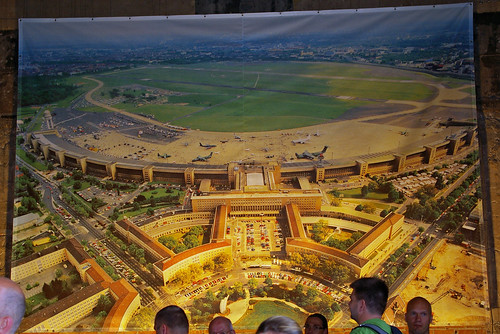
The thing is though, that the airport – at the referendum in April – didn’t get enough votes to stay open. Just over 500,000 Berliners voted to keep the options open – less than 25% of the electorate even bothered to turn up. So, the airport is closing, and facing a slow painful death.
So, why was it so important to me to go on this tour? For me, Templehof airport is a glimpse into the past. It’s a glimpse into the 1920’s, a world of flappers, jazz music, modern art-deco architecture. A world where architecture plans were dominated and changed repeatedly by the third reich, planned in part by Hitler, and dreamed of by the Germans as they hoped to embark on a larger than life (and ill fated)bit of glory in the form of WW2. It was a part of a world where the cold war split a city in two, dropped aid from the sky for years, and, when the wall fell – helped to reunite the city by becoming a way for everyone to travel to/from the airport at the same time as other – more modern – airports were built. This was a chance to document history as it prepares to change – all in the name of progress.
The old terminal, originally constructed in 1927, received politicians and celebrities from around the world during the 1930s. As part of
Albert Speer‘s plan for the reconstruction of Berlin during the Nazi era, Prof.
Ernst Sagebiel was ordered to replace the old terminal with a new terminal building in 1934.
The airport halls and the neighbouring buildings, intended to become the gateway to Europe and a symbol of Hitler’s “world capital”
Germania, are still known as the largest built entities worldwide, and have been described by British architect
Sir Norman Foster as “the mother of all airports”. With its façades of
shell limestone, the terminal building, built between 1936 and 1941, forms a massive 1.2-kilometre long
quadrant yet has a charmingly intimate feel; planes can taxi right up to the building and unload, sheltered from the weather by its enormous overhanging canopy. Passengers walk through
customs controls and find themselves in a dazzlingly simple and luminous reception hall. Tempelhof is served conveniently by the
U6 U-Bahn line along Mehringdamm and up
Friedrichstraße (
Platz der Luftbrücke station).
Zentralflughafen Tempelhof-Berlin had an advantage of central location just minutes from the heart of Berlin and quickly became one of the world’s busiest airports. Tempelhof saw its greatest pre-war days during 1938–1939 when more than 52 foreign and 40 domestic aircraft arrived and departed daily.
The air terminal was designed as headquarters for Deutsche Lufthansa, the German national airline. As a forerunner of today’s modern airports, the building was designed with many unique features including giant arc-shaped hangars for aircraft parking. Although under construction for more than ten years, it was never finished because of
World War II.
The building complex was designed to resemble an eagle in flight with semicircular hangars forming the bird’s spread wings. A mile long hangar roof was to have been laid in tiers to form a stadium for spectators at air and ground demonstrations for up to one million people.”
All of the pictures attached on this are my own, and copyright by me. I hope you will take a minute to look, think and read of the history of this mighty airport which is being closed in the name of progress. There are no plans to tear down portions of it – yet. Most of it is historically protected, including the green space where the runways and tarmacs currently are. However, this site is endangered – because once it’s closed, with no buyers, and no plans (other than the green space becoming a park) – it will surely be left to rot – much like many other buildings in the city.
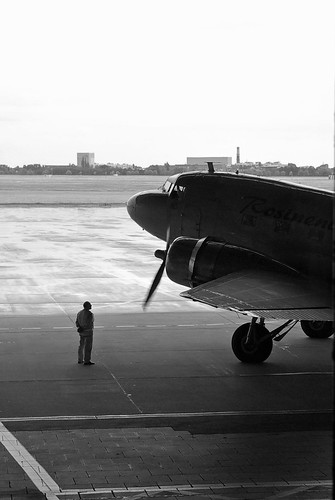
So, it is that we in Berlin are saying good bye to an old friend. Templehof airport was never finished, the plans are there – the ideas are there – and had it been finished, it truly would have been a timeless masterpiece dedicated to one thing we humans can’t do – FLY.
I started to add pictures, then decided to provide a link – it’s just easier that way. The pictures are at: Templehof Airport Tour on my Flickr Site.