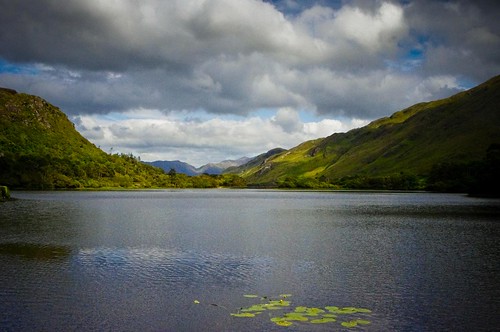
Kylemore Abbey

Lough Pollacappul, Connemara

Continuing my travels up the West coast of Ireland last summer, I drove from Salthill’s beautiful Galway Bay hotel, through Connemara and its detours, and then on to Kylemore Abbey.
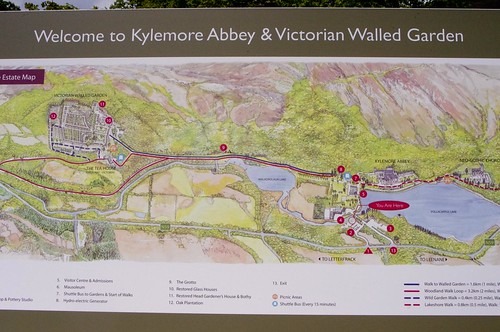
Map of the grounds & gardens of Kylemore Abbey

The story of Kylemore Abbey is a story of love and loss, vision and tragedy, and finally hope. Without getting deep into the building’s history, I’ll try to hit the high points of the history, and for more details, you can go to the Kylemore Abbey website here.
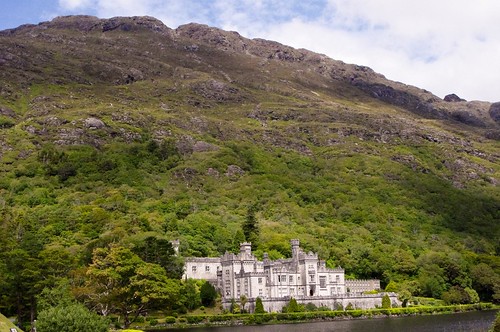
Druchruach Mountain & Kylemore Abbey

Back in the late 1800’s, an English surgeon named Mitchell Henry and his wife, Margaret, were married. They came to Connemara on their honeymoon and were enchanted by the area’s wonderful hunting and fishing. They vowed to one day return and build a home in such a beautiful place. When Henry’s father died, Henry received a large inheritance and decided to give up medicine for business and politics. He and Margaret bought property in Connemara (some 13,000 acres in land) around the old Kylemore hunting lodge. The property included mountains, a lake and boglands. Margaret and Henry started to build a 70 room home – what is the main portion of the Abbey today, in a Victorian Style Castle. They built the castle in the shadow of Druchruach Mountain and hugging the shores of Lough Pollacappul, to maximize the view. By 1871, the castle and the walled garden were completed. In 1874, while on holiday in Egypt, Margaret died, leaving behind her broken hearted husband and 9 children. Mitchell sent her body back to Kylemore and in the coming years, built a mausoleum in the style of an old gothic church along the side of of Lough Pollacappul to commemorate their love. For 40 years, Mitchell and his family encouraged locals to take up tenancy on his property – and during the time of the Irish Potato famine he is known to have provided work, food and schooling for those that he shared the land with.
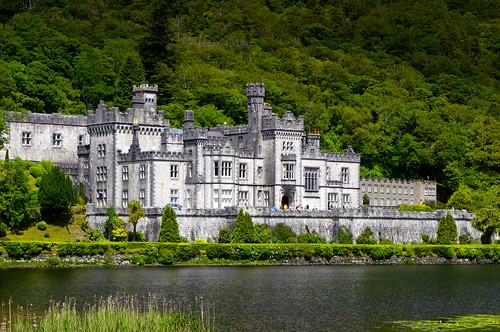
Kylemore Abbey & Lough Pollacappul

In 1903, English King Edward VII came to Connemara to visit and toured the property and grounds. Shortly thereafter, Kylemore Abbey was sold to the Duke & Dutchess of Manchester, who bought the home and its grounds in 1909. Sadly, in 1914, The Dutchess of Manchester’s father, Eugene Zimmerman passed away – and because he was financing the home – the property was lost to the bankers.

The property remained mostly empty (caretakers were watching over it) until the 1920’s, when the Benedictine Nuns of Ireland purchased the land and property. They established a convent, guest house, series of gardens, and a Girls School (the school closed in the 1990’s). Today, the Benedictine Nuns still hold the property, making their money off of the location as a tourist attraction and selling their wares locally while doing good works in the local community.
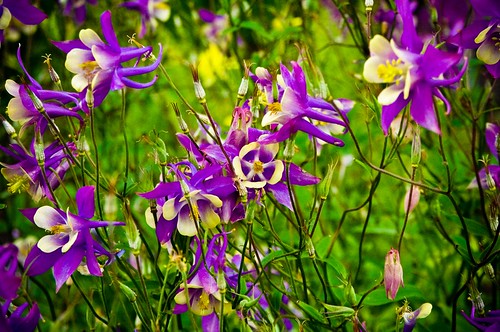
Grounds of Kylemore Abbey

While I didn’t have time (a 2 hour detour does this to ya!) to see inside the house or the Gothic cathedral, I did make it to the gardens, which I’ll post pictures of tomorrow – but for now, a preview of some of the flowers.

Share

Salthill near Galway

Galway Bay Hotel

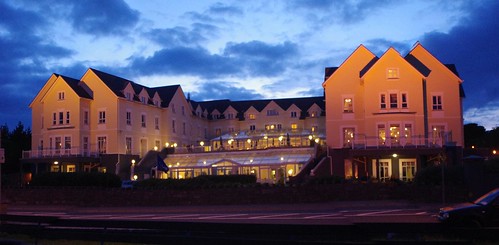
Back in July 2011, I had a few days off and decided to go to the West coast of Ireland and stay near Galway. After some perusing about the hotels, I found a beautiful looking hotel called the Galway Bay Hotel, on the North Side of Galway in a suburb called Salthill. The hotel faces the sea front promenade around Galway Bay and has interesting warm yellow architecture. The inside is very elegant with marble floored oval foyer with custom dark wood seating. The Foyer opens onto an all glass conservatory from which you can reach a lovely summer terrace with chairs and tables so one can take in the brisk sea air and a bit of sun on warm days. I got a prime room – on the top floor, and facing the beach – with a huge king size bed – for a good deal of less than 100 euro a night. Despite the drizzle for most of the day, the view (below) was magnificent.

view from my room at Galway Bay Hotel

I had a massage, and a chance to soak in the tub and relax. By the time that I was ready for diner, the weather was clearer and cooler – but twilight had set in. I walked over to the village…

Salthill village

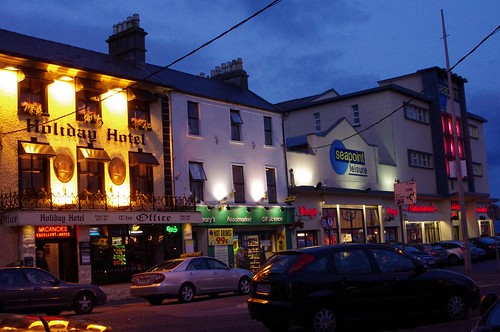
and opted for a Slavic restaurant that promised authentic perogies. Now I’m no expert, but I did have lots of Perogies when I lived in Russia. I was a bit skeptical at first, but when I asked the waitress what type of perogies they had – and she told me the names I was familiar with, I got my hopes up and was not disappointed (seriously the best perogies I had since I lived in Russia!). Add in a bit of tasty pear vodka and also a bit of yummy dessert and I was one happy girl. (Who would have thought that such a tiny town would have such an awesome restaurant?)

Perogies for dinner!

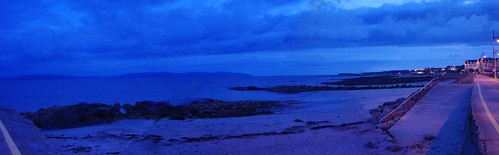
On the way back to the hotel, walking along the promenade, I did try to take a picture of Galway’s lovely Bay with an tanker sitting out on the water. It’s blue because of the twilight – and I wanted to try again later (no chance – it started raining again and did most of the morning – thus why I headed to Connemara/Kylemore Abbey) but I think it came out ok.

Salthill Promenade view

Share

Glendalough Ruins and Lakes

Back in March, and again the beginning of June, I decided that I needed to get out of the city and go see a bit more of Ireland. I had heard many lovely things about a place called “Glenda-lock”, which is situated in the Wicklow mountains. I have to say that after taking a friend there in March, I had to return in June (when the weather was better) and take my mom and a bunch of photographs.

IMGP1220-67
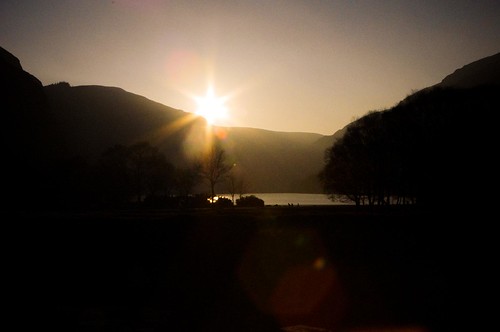
(Sunset at the Upper Lake at Glendalough)

Glendalough (Irish: Gleann Dá Loch, meaning “Glen of Two Lakes”) is one of the most visited places in Ireland. It’s located in the Wicklow Mountains National Park and has lots of walks and trails. The Glendalough Valley was carved out by glaciers during the Ice Age and the two lakes, from which Glendalough gets its name, were formed when the ice eventually thawed.

IMGP1175-39
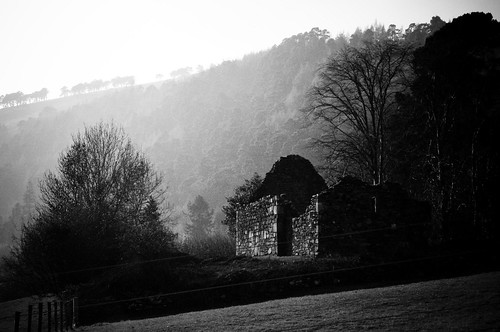
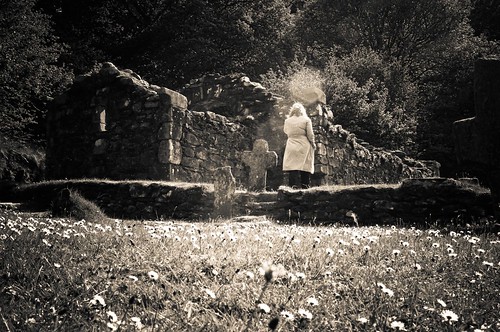
(House ruins with foggy mountain in the background)

It is also renowned for its Early Medieval monastic settlement founded in the 6th century by St Kevin, a hermit priest (now in ruins). Kevin was born to one of the ruling families of Leinster, and studed under several early Christian leaders. During this time, he went to Glendalough and was enchanted by its beauty.

IMGP1592-7
(St. Kevin’s Cell)

IMGP1597-1
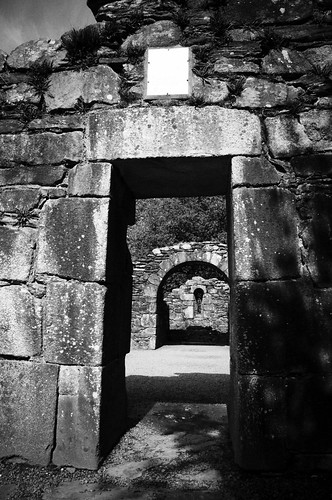
(Looking through the interior of St. Kevin’s Cell)

Shortly later, St. Kevin returned with several monks to found a monestary. As his fame spread, the settlement grew. Kevin died in 618, but the settlement continued for nearly 600 years – surviving through Viking Raids and deaths of many Abbots. In 1398, English troops finally invaded and destroyed the peaceful monestary for good.

IMGP1139-10>
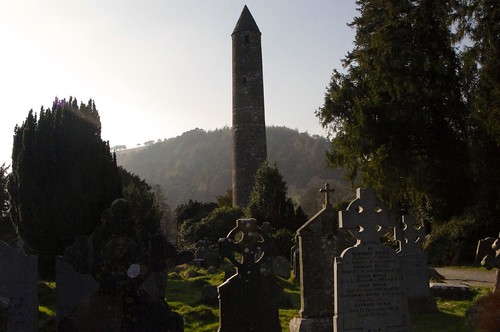
(Cemetery with 30 meter high Round tower to watch for raiders – Lower lake of Glendalough)

Since then, the place has remained one of pilgrimage, and I can see why as it’s one of the most beautiful places I’ve ever seen. It’s mentioned in many manuscripts and there are remnants of cemeteries, workshops, guest houses, infirmaries, farm buildings and dwellings all over the upper and lower lakes. Most of the buildings that exist today are from the 10th and 12th centuries.

IMGP1169-33
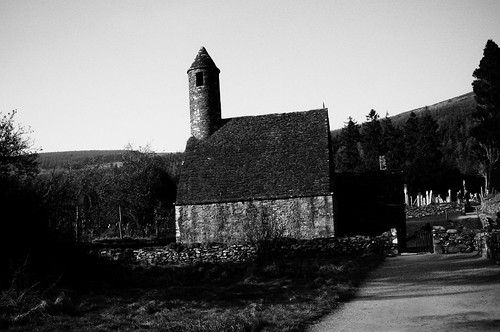
(St. Kevin’s church)

For More information, please see http://www.glendalough.ie/heritage_of_glendalough.php

For more pictures of my trips there, please see my flickr set.

Share