Love Lollys

Love Lollies

Happy Valentine’s Day!

For my colleagues today, I thought it would be fun to make a few Valentines. I wasn’t sure what to do this year, and then I saw a simple idea on one of the Martha Stewart pages here.

Love lollies 2

After gathering some lollypops and some colored paper, I thought it would be brilliant to cut some heart shapes out of the paper using both the scissors and a hole punch. I then glued all of the shapes together and hole punched the main larger hearts. Sliding the heart “petals” up the stem of the lollypop and securing on the reverse side with tape (being careful to NOT tape the paper on the lolly) I think they made some cute flowers.

Love Lollies 4

Next time, I think I’ll try making some with words on them (like fun Valentine’s Day slogans or something), or maybe adding some other features like ribbons. Otherwise, I would say this is a great craft for the kids too!

Share

Kylemore Abbey

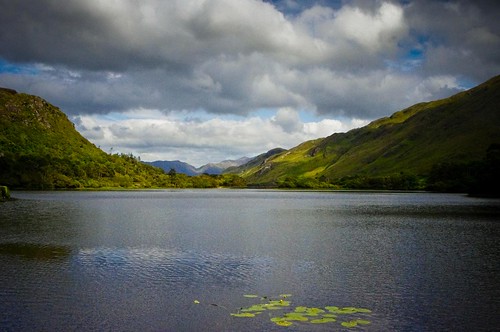
Lough Pollacappul, Connemara

Continuing my travels up the West coast of Ireland last summer, I drove from Salthill’s beautiful Galway Bay hotel, through Connemara and its detours, and then on to Kylemore Abbey.
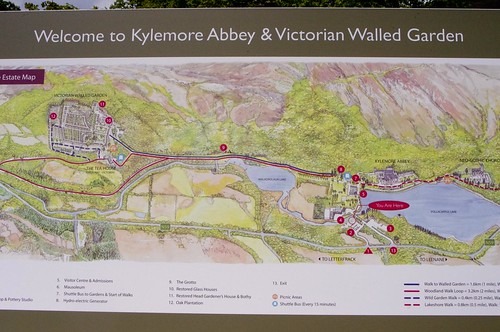
Map of the grounds & gardens of Kylemore Abbey

The story of Kylemore Abbey is a story of love and loss, vision and tragedy, and finally hope. Without getting deep into the building’s history, I’ll try to hit the high points of the history, and for more details, you can go to the Kylemore Abbey website here.
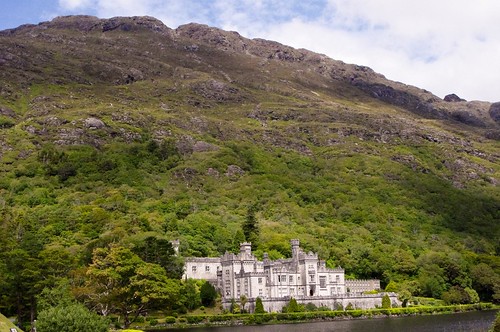
Druchruach Mountain & Kylemore Abbey

Back in the late 1800’s, an English surgeon named Mitchell Henry and his wife, Margaret, were married. They came to Connemara on their honeymoon and were enchanted by the area’s wonderful hunting and fishing. They vowed to one day return and build a home in such a beautiful place. When Henry’s father died, Henry received a large inheritance and decided to give up medicine for business and politics. He and Margaret bought property in Connemara (some 13,000 acres in land) around the old Kylemore hunting lodge. The property included mountains, a lake and boglands. Margaret and Henry started to build a 70 room home – what is the main portion of the Abbey today, in a Victorian Style Castle. They built the castle in the shadow of Druchruach Mountain and hugging the shores of Lough Pollacappul, to maximize the view. By 1871, the castle and the walled garden were completed. In 1874, while on holiday in Egypt, Margaret died, leaving behind her broken hearted husband and 9 children. Mitchell sent her body back to Kylemore and in the coming years, built a mausoleum in the style of an old gothic church along the side of of Lough Pollacappul to commemorate their love. For 40 years, Mitchell and his family encouraged locals to take up tenancy on his property – and during the time of the Irish Potato famine he is known to have provided work, food and schooling for those that he shared the land with.
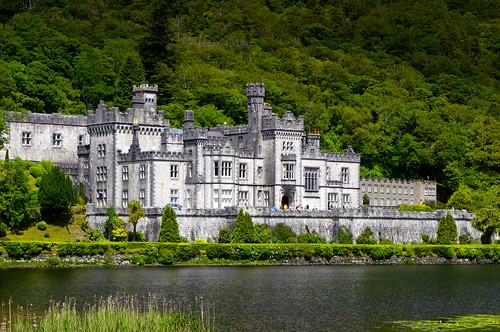
Kylemore Abbey & Lough Pollacappul

In 1903, English King Edward VII came to Connemara to visit and toured the property and grounds. Shortly thereafter, Kylemore Abbey was sold to the Duke & Dutchess of Manchester, who bought the home and its grounds in 1909. Sadly, in 1914, The Dutchess of Manchester’s father, Eugene Zimmerman passed away – and because he was financing the home – the property was lost to the bankers.

The property remained mostly empty (caretakers were watching over it) until the 1920’s, when the Benedictine Nuns of Ireland purchased the land and property. They established a convent, guest house, series of gardens, and a Girls School (the school closed in the 1990’s). Today, the Benedictine Nuns still hold the property, making their money off of the location as a tourist attraction and selling their wares locally while doing good works in the local community.
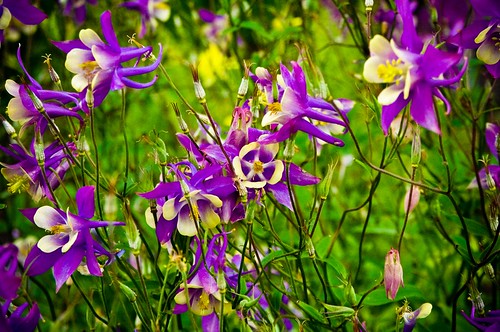
Grounds of Kylemore Abbey

While I didn’t have time (a 2 hour detour does this to ya!) to see inside the house or the Gothic cathedral, I did make it to the gardens, which I’ll post pictures of tomorrow – but for now, a preview of some of the flowers.


Share

Connemara Detours 2

Yesterday, I started telling you about the trip from Galway to Kylemore Abbey and how I got detoured nearly 2 hours. You can see the post here.

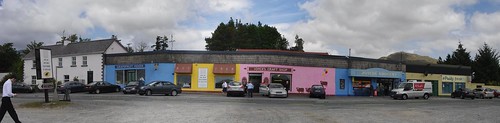
Joyce Craft Shop Panorama

By the time I made it to the James Joyce craft and gift shop, I was ready for a break. I’d been battling down very narrow, winding roads, and past several sheep and cars on roads which proved to be a bit stressful since they weren’t on a map and nothing was labelled. The craft shop is on the N59 road, and after not having seen any place to stop, this looked like a nice place – not only because of the complex of small shops – but also because it had a couple of eye catching monuments that made me want to stop. Pulling over, however, I found that the monuments were rife with Irish humor.

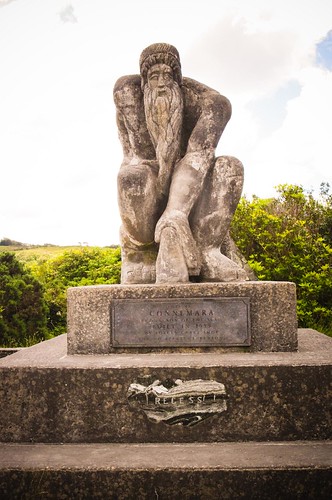
Connemara Giant

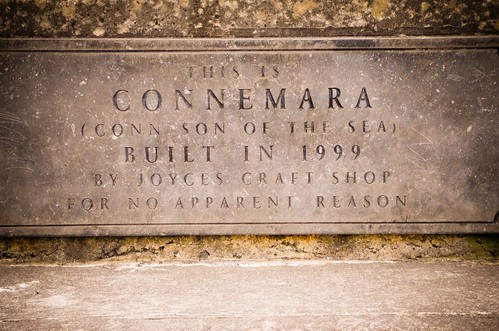
This is a sculpture of the Connemara Giant. It’s huge, and made out of granite. It sits directly in front of a sort of art deco shield type monument, which one would expect would have names or commemorate something important. Upon closer inspection, the sign under the Giant says:

Connemara Giant, no apparent reason


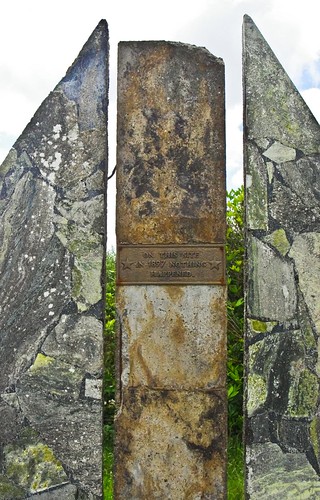
The giant was erected for no apparent reason. It cracked me up. As I maneuvered myself around to the second monument that sits just behind the Giant, I was again greeted with a but of humor that even PT Barnum would have appreciated.

Connemara Giant monument

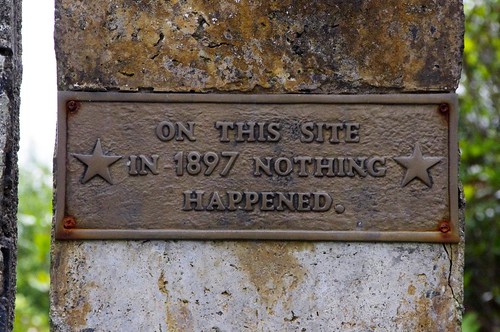
Yep, on this site in 1897, Nothing Happened.

On this spot in 1897 Nothing happened

After getting a drink and a couple munchies, springing for a couple postcards (mailed off to the family), and even a piece of beautiful green Connemara jewelry, I headed off again, hoping to make Kylemore Abbey in a short time. The roads the rest of the way to Connemara weren’t bad at all – despite seeing more and more sheep along the road…

Sheep Rush hour on the road to Connemara

More from the beautiful Kylemore Abbey tomorrow – including the story of the love that it was built for.

Share