The Proleek Dolmen

Proleek Dolmen, near Dundalk In part 1, I took you around the Proleek Wedge tomb and told of the Irish legend that surrounds it.

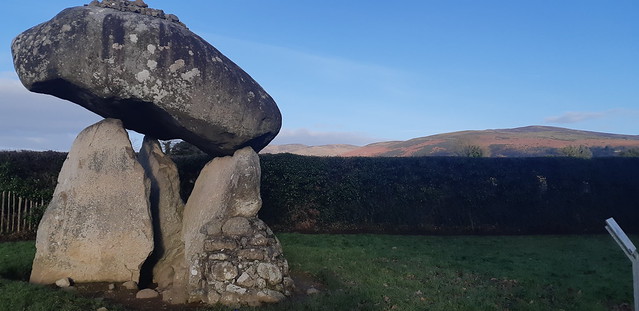
A short walk away on the same golf course is what is quite possibly Ireland’s most photographed dolmen. A dolmen is a type of single-chamber megalithic tomb, usually consisting of two or more vertical megaliths supporting a large flat horizontal capstone or “table” in a “tripod” type style. This one is named the Proleek Dolmen. Irish linguists suggest that Proleek means “the Death Stones,” or the “Dinner Stones.

You may wonder why there are so many small stones on top of this monument. Well, an interesting bit of folklore here says that if you are successful in tossing three consecutive pebbles up to the top of the capstone, without any rolling off, you will get a wish. Another version of the legend states that whoever manages the feat will be married within the year.

@phoenixrosedsgn part 2 #Megalithic #monuments Proleek #Dolmen near #Dundalk #Ireland #Legend #History #tomb #discoverIreland #exploreIreland #travel #tourism #irl ♬ Fantastic sad music background music(842811) – COLOR MUSICA
The Proleek Dolmen is a north-west facing structure which dates from c. 3000 BCE stands at around 3.5 metres (over 13 feet tall), this huge megalith has a capstone 3.8 metres (12.5 feet) in length and weighing at least 40 tons! That’s one impressive balancing act!

The dolmen has been aligned so that it’s opening points toward the peak at Sleive Guillon so it can take advantage of the setting sun of the summer solstice. (Of course, it’s January and almost sunset so the sun is on the wrong side…but it’s stunning nonetheless).

P.S. I want to rename it the 3 sisters who hold up the moon… what do you think? Proleek Dolmen, near Dundalk
Share

Cahir Castle

Exploring Ireland is always a fun thing -especially when I have companions to go exploring with! Today, I’ve headed to Cahir Castle. I’ve been here before with my friend A; and on my own, and this time I decided that Mr.🐟 would love to see this impressive castle – so in the car we went and a couple hours later – arrived to Cahir, and the gorgeous castle.

Untitled
View of Cahir Castle in Spring with the road to the right.

Cahir Castle was first built in wood in 1142 by Conchobar Ua Briain, King of Thomond, on what was then an island in the River Suir, and replaced an older stone ring fort (Irish: Cathir) at the same location. This “stone fort” lent its name to the castle and later, the town that grew up around the castle (Cahir).

The Castle grew in two parts, with the side nearest the main street and bridge being built about the 13th century when the original fortress was granted to James Butler, newly created Earl of Ormond, for his loyalty to English King Edward III. The Butler family became very powerful, and in the 1500’s (about 200 years later) added in the section of the castle which now houses the Audio-Visual presentation. By 1542 when the first of the Barons Cahir was created, and during the Tudor – Elizabethan era, the Butlers in Ireland sided with the Catholics.

Cahir Castle / Swiss cottage Co. TipperaryView of castle from inch field / park area

Despite being thought of as rather impregnable (It had stood strong for nearly 400 years) in 1599, during the reign of Queen Elizabeth, the castle was beseiged by Robert Devereux, the Earl of Essex before finally falling to heavy artillery that was used against it for the first time. Sir Charles Blount was put in charge of the castle and area for a year – until Lord Cahir joined with the Earl of Tyrone in 1601 took it back (he was charged with treason and later freed). In 1627, Cahir’s son-in-law, Lord Dunboyne, shockingly murdered his distant cousin, James Prendergast, at the castle in a dispute over an inheritance. Dunboyne was he was tried for the killing but acquitted not long after.

Untitled inside the great hall

During the Irish Confederate Wars it was besieged twice more, in 1647 and 1650. Out of “date” design wise, the castle fell into ruin in the late 1700s before being partially restored (the great hall) in the 1840s. While mostly disused, the castle then remained in the Butler family line (Lord Cahir) until 1961 when the last Lord Cahir died and the castle became the property of Ireland. Tours and visits are currently run by the Office of Public works (OPW).

Cahir Castle, County Tipperary; Ireland

A short Tiktok of my third visit is below (note that the outside area only was open during covid and the photos above are from the other 2 visits).

@phoenixrosedsgn lets explore #Cahir #Castle #Tipperary #Ireland #free #opw #staycation #history #travel #tourism #thingstodo #midevilcastle ♬ Wasted by the Water (Original Club Mix) – Joe & Cahir

Share

Hiking to the Hellfire Club

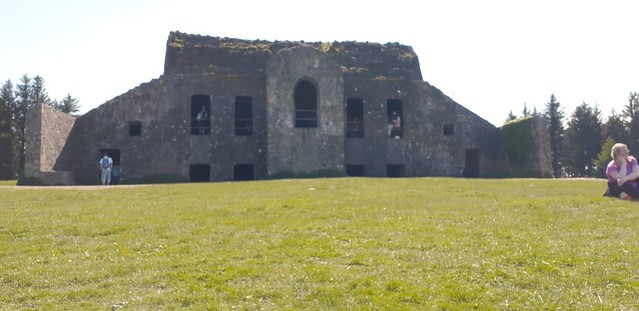
Hike to hellfire club, mountpelier Dublin. Sunday 21C and Sun. What to do? Get out and hike to #hellfireclub on Montpelier Hill, in the #dublin Mountains. It’s a short and relatively easy walk (minus the steep part at the very beginning) from the parking area to the top, where the ruins of an old hunting lodge is located. (Scroll to the bottom for my tiktok video of the trip).

Hike to hellfire club, mountpelier Dublin. Originally there was a passage grave with a cairn at the top of the hill, but these were dismantled around 1725, when stones were re-used for a new building. At the time, Parliament Speaker Conolly, one of the wealthiest men in Ireland, built a two bedroom hunting lodge on top of the old site, which he named ‘The Brass Castle’. Shortly after completion, a storm blew the roof off. Local Irish folklore says that this was the of the Devil – as a punishment for interfering with the burial cairn.

After Conolly’s death in 1729, the hunting lodge was sold. The new buyers were a part of the Irish Hell Fire Club (believed to be one of the first groups of Free Masons in Ireland), which was active in the years 1735 to 1741, and used the renamed Mount Pelier lodge as a meeting place. Founded in 1735 by Richard Parsons, he was a known dabbler in black magic and the occult. He also ran the “hell fire club” a so called club of “wild young gentlemen” who used a tavern in Cork Hill (by Dublin Castle) as their meeting place, but were dismissed for bad behaviour hence the name “Hellfire Club”. In it’s hayday, members met at locations across Dublin and were known for their amoral behaviour and debauchery involving alcohol and sex. Local stories also call some of the “club” members satanists and devil worshipers and even go so far as to say that president of the club was named ‘The King of Hell’ and dressed like Satan, with horns, wings and hooves.

At any rate, in 1740, the house was burned down, leaving only a burnt out shell of stone and concrete. The ‘hell fire club’ moved on to a different location to meet (the club was later disbanded in 1741). Today, the ruins provide a backdrop that locals like to go explore (and toilet in the ruins), picnic on the front grounds, and enjoy the views and fresh air above Dublin on a Sunny day.

@phoenixrosedsgn Sunday 21C and Sun. What to do? Get out and hike to #hellfireclub , in the #dublin ♬ Calypso – John Denver
Share